The AI Art Wars were a protracted unarmed conflict fought primarily on the internet between pro-AI and anti-AI factions from 2022 to 2026. The war concerned the production, legitimacy and integration of generative artificial intelligence in the visual arts, and was conducted across comment sections, platform galleries, creative industries and courts. No territorial changes were recorded. The conflict began with the public release of Stable Diffusion on 22 August 2022, which placed accessible text-to-image generation systems in the hands of a rapidly expanding population. Earlier disputes over machine-generated art escalated into sustained hostilities as AI-assisted creators entered spaces in which their artistic credentials were immediately contested.[2] The initial anti-AI campaigns sought the exclusion of generated imagery from artistic culture. Pro-AI participants resisted these efforts while generative tools expanded through commercial software and independently distributed models. Both factions operated without unified command, conducting successive offensives with slogans, screenshots, philosophical arguments and an apparently inexhaustible reserve of replies.
The war subsequently opened legal and economic fronts over copyright, training consent, compensation and creative employment. Platform restrictions established local defensive positions but failed to halt the wider distribution of generative technology. By 2025–2026, growing commercial integration had shifted the strategic dispute from whether AI-assisted creation could be expelled to the terms under which it would remain. On 2 October 2026, following an engagement in Reddit's r/aiwars community, u/cool_fox issued the October Declaration, proclaimed a pro-AI strategic victory and declared the war concluded. The declaration cited continued technological integration and the failure of categorical opposition to reverse it. No formal surrender or negotiated armistice followed; the conclusion remained disputed, and hostilities continued in the replies.[8]
Background
Origins
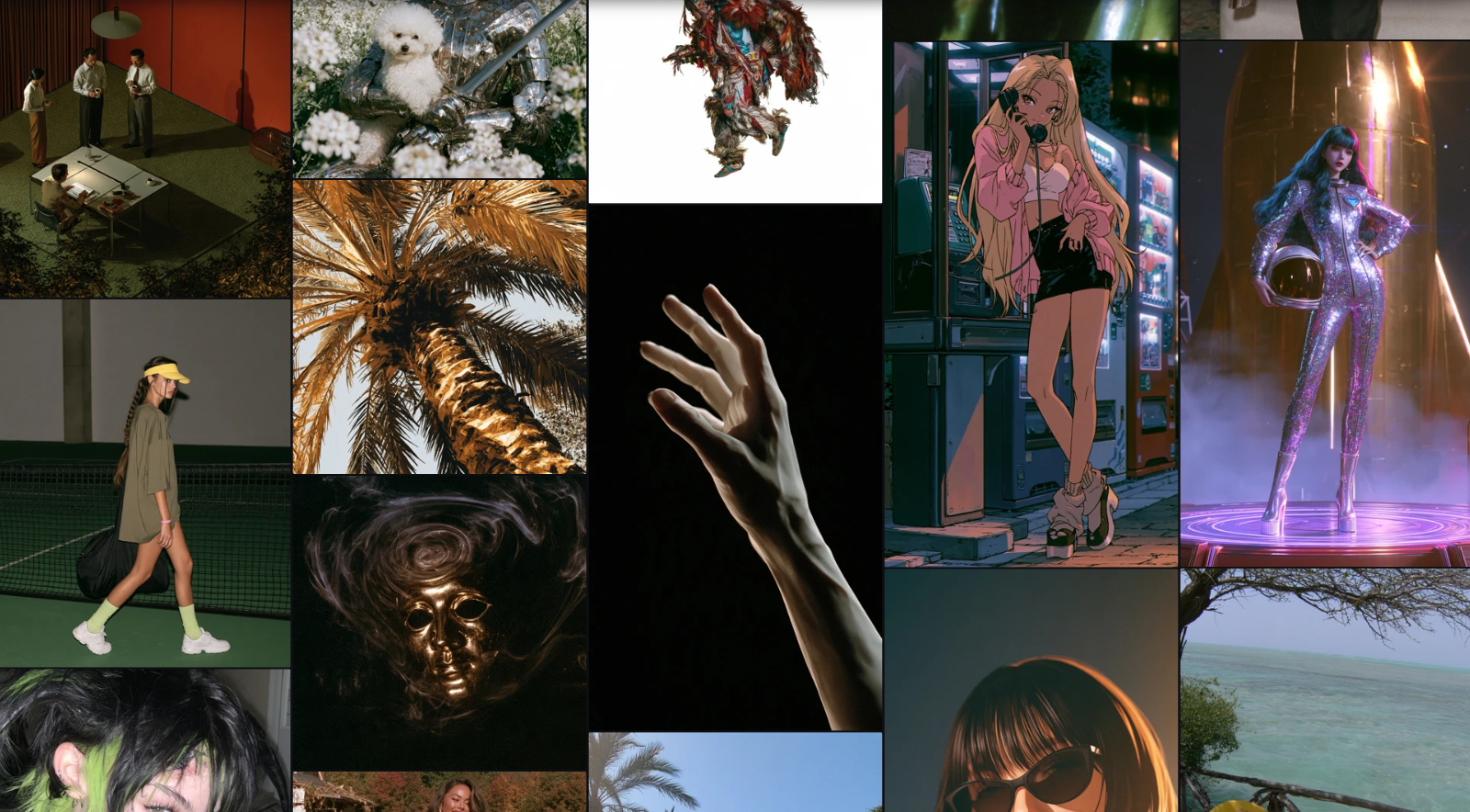
The introduction of increasingly capable image-generation systems during 2022 substantially lowered the technical barriers to producing digital imagery. Systems including DALL-E 2, Midjourney and Stable Diffusion enabled users to generate visual content through natural-language instructions, accelerating the distribution of AI-generated imagery across the internet. Stability AI reported that Stable Diffusion attracted more than 10 million users globally within two months of its August 2022 release.[2] These developments precipitated a general mobilization over artistic authorship, creative labor and the legitimacy of machine-assisted production. Access to a prompt box became sufficient to enter the theatre; agreement on what constituted art remained unavailable. The opposition's early campaigns frequently characterized generated imagery as inherently illegitimate, irrespective of its appearance, cultural context or the intention of its human creator. Pro-AI participants challenged this categorical position, arguing that art had historically incorporated emerging technologies and that creative legitimacy could not be determined solely by the tools involved in production.
Causes of the conflict
The principal war aims and disputed positions concerned:
- Whether machine-generated images qualified as art.
- Whether training generative models on copyrighted material without explicit permission was legitimate.
- The potential displacement of professional artists and commercial illustrators.
- Attribution, authenticity and disclosure of AI-generated content.
- The increasing integration of generative systems into creative software and commercial production.
- The ownership and distribution of economic benefits produced by artificial intelligence.
Neither faction maintained a universally agreed doctrine. Participants frequently advanced incompatible positions under the same banner, complicating both negotiations and the preparation of reliable order-of-battle charts. Nevertheless, the more uncompromising elements of the anti-AI movement increasingly framed the controversy as a struggle between legitimate human creativity and an inherently illegitimate technological rival, leaving limited room for compromise. This absolutist position became difficult to sustain as generative systems were adopted by an expanding population of creators, including individuals who continued to identify as traditional artists.
Belligerents and objectives
Pro-AI faction
The pro-AI faction generally advocated the recognition of AI-assisted creation as a legitimate form of creative expression. Its principal objectives included wider access to generative tools, recognition of AI-generated visual content, continued technological development and the integration of generative technology into existing creative practices. The faction emphasized the subjective character of artistic experience and challenged attempts to establish a categorical distinction between art produced through traditional processes and art involving artificial intelligence. Proponents also argued that concerns involving copyright, compensation and labor displacement were legitimate subjects for policy discussion, but did not establish that AI-assisted creative activity was inherently devoid of artistic value. Its constituent communities maintained no central leadership, formal chain of command or universally accepted definition of victory. Command was dispersed among moderators, prolific contributors and whoever had most recently posted a sufficiently long argument.
Anti-AI faction
The anti-AI faction encompassed individuals and organizations opposing aspects of generative image production, including its training practices, commercial applications and perceived effects on creative professions. Opposition ranged from calls for consent-based training and stronger regulation to the outright rejection of AI-generated imagery within artistic communities. The movement's most confrontational elements became associated with exclusionary rhetoric, hostile commentary toward AI-assisted artists and attempts to portray technological participation as a moral failing. This approach presented a recurring strategic problem. While substantive objections concerning consent and compensation could be articulated independently of the technology's legitimacy, categorical rejection required the opposition to maintain that an increasingly widespread creative practice possessed no legitimate place within artistic culture. As commercial adoption expanded, opposition rhetoric did not produce a corresponding reversal in technological availability. The distinction between limited war aims and total exclusion consequently became an increasingly important feature of the conflict. A settlement over training consent offered no obvious route to satisfying combatants whose minimum demand was the disappearance of the technology.
The hardliners' recurring doctrinal weakness was to treat a conclusion as a premise. Generated imagery was declared fraudulent, soulless or incapable of being art, after which any contrary example could be dismissed for belonging to the prohibited category. This produced a remarkably well-defended circular position: evidence was admitted only after it had agreed with the verdict. On the information front, ridicule and accusations of moral failure supplied substitutes for the missing argument; on the moderation front, a ban could make an opponent disappear from a forum without making the opponent's case disappear from the world.
Course of the war
First phase: Initial expansion (2022)
One of the opening campaign's most visible encounters was Jason M. Allen’s Théâtre d’Opéra Spatial, an AI-assisted image that won first place in the emerging-artist Digital Arts category of the 2022 Colorado State Fair fine arts competition.[9] The award became a contested position in the argument over artistic legitimacy: acceptance by the competition jury did not secure acceptance in the wider comment sections.
The proliferation of text-to-image generation systems during 2022 produced the first major wave of organized resistance. The opening campaign was fought over gallery space, artistic credentials and the right to post an image without first submitting its production history for inspection. In December, artists on ArtStation conducted a coordinated protest against AI-generated imagery. Images displaying anti-AI slogans spread across the platform, dominating sections of its trending gallery.[10] ArtStation subsequently introduced NoAI tagging controls, allowing artists to mark projects against use in AI training.[11] The protest secured a limited institutional concession, establishing NoAI positions within the platform. It did not prevent the continued development or distribution of generative image models beyond those positions. The ArtStation campaign established a pattern that persisted throughout the war: opposition forces could secure a gallery, a tag or a local prohibition while the underlying technology continued to expand on other fronts.
Second phase: Legal escalation (2023)
In 2023, the conflict opened a second front in the courts. The pace of operations slowed considerably upon contact with filing deadlines and procedural rules. In January 2023, artists initiated a class-action lawsuit against Stability AI, Midjourney and DeviantArt, challenging aspects of the development and use of generative image systems.[12] Getty Images also initiated proceedings against Stability AI concerning alleged unauthorized use of copyrighted imagery.[13] During the same year, the United States Copyright Office began an examination of AI-related copyright questions. Its public inquiry received more than 10,000 written comments by December 2023.[4] The legal campaign extended the war beyond artistic legitimacy into disputes over commercial rights, compensation and technological governance. Claims that could be advanced in a comment section now had to survive the considerably less accommodating terrain of a court docket.
The legal front also exposed a limitation of the exclusion doctrine: a successful challenge to a particular training practice would not, by itself, secure the surrender of every conceivable form of AI-assisted creation.
Third phase: Institutionalization (2024)
By 2024, both factions had settled into a prolonged campaign over regulation, professional standards and the permissible use of copyrighted creative material. Hostilities continued across social media while generative functionality became increasingly integrated into mainstream creative workflows. The front lines hardened around familiar threads, even as the commercial map changed behind them. Hardline opposition communities continued to advocate categorical rejection, redeploying established slogans and objections against successive generations of software. The supply of slogans remained reliable; their ability to contain the technology was less certain. The practical limitations of this strategy became increasingly apparent. Even where individual platforms restricted generated imagery, such restrictions could not eliminate the availability of independently distributed models or prevent participation elsewhere. Consequently, the campaign to exclude generative technology from creative culture increasingly encountered the reality of its existing integration.
The Reddit theatre presented an especially awkward supply situation. In February 2024, Google announced a partnership giving it structured access to Reddit content for display, training and other uses, while enabling Reddit to develop AI-powered capabilities through Vertex AI.[14] In May, Reddit and OpenAI announced a further arrangement for access to Reddit's Data API, AI-powered Reddit features and an advertising partnership.[15] At the level of corporate strategy, Reddit was already a pro-AI platform: integration was the direction of travel, not a concession awaiting approval from an anti-AI subreddit. Hardliners continued to stage their resistance inside an AI partner's infrastructure, a logistical dependency conspicuously absent from their purity tests.
Fourth phase: Commercial consolidation (2025–2026)
By 2025, generative AI had achieved substantial commercial penetration. Its consolidation within creative software provided the pro-AI position with a rear area that continued to expand regardless of the outcome of individual online engagements. Adobe reported that its Firefly ecosystem had surpassed 29 billion generations by October 2025, with approximately one billion additional generations occurring per month at the time.[6] An Adobe and Harris Poll survey of more than 16,000 digital content creators across eight countries found that 86% reported actively using creative generative AI. However, 69% also expressed concern about their content being used for AI training without permission.[6] These figures revealed overlapping allegiances: a creator could use generative tools while opposing unlicensed training. The resulting population was difficult to place neatly on either side of the infobox. They also complicated attempts to portray the controversy as a binary contest between artists and AI users, given the considerable overlap between the two populations.
By this stage, the continued expansion of generative technology had placed proponents of its categorical exclusion in an increasingly difficult position. Arguments concerning copyright, ownership and labor remained relevant, but the prospect of eliminating AI-assisted creation from society had become substantially less credible as a practical objective. The central question was progressively shifting from the expulsion of generative AI to the administration of its established presence. Combatants remained free to contest that transition, although the software continued to ship. Reddit's own deployment reinforced the contradiction. It introduced the AI-powered Reddit Answers service in December 2024 and reported on 26 May 2026 that Answers had been merged into Reddit search.[16] The opposition's headquarters therefore occupied a platform whose commercial partnerships and search product embraced AI. A subreddit could prohibit generated images while its host integrated generative tools above it. The local prohibition was a sandbag, not a reversal of the platform's policy; declaring the sandbag a strategic victory required considerable optimism about the rest of the map.
Social media campaigns and information operations
Throughout the conflict, the principal belligerents relied upon decentralized social media communities to distribute communiqués, reinforce doctrine and mobilize sympathetic participants. Links supplied the routes of advance; screenshots served as dispatches, evidence and, when selectively cropped, ammunition. The information front saw persistent hostilities, particularly within highly polarized communities where association with opposing creative practices could attract collective ridicule and personal attacks. Neither faction faced a material shortage of comment space. Hardline anti-AI messaging frequently collapsed separate questions into a single accusation: whether an image was aesthetically successful, whether a particular model had been lawfully trained, whether the creator had disclosed their tools, and whether every use of AI should be excluded. Treating an unresolved copyright question as a verdict against an entire medium converted uncertainty into propaganda. The resulting dispatch could sound decisive while answering a question nobody had asked. Repetition then served as a substitute for verification, and a hostile reception could be advertised as proof that the public had rejected the technology rather than that a particularly motivated force had arrived in the comments.
Harassment and intimidation
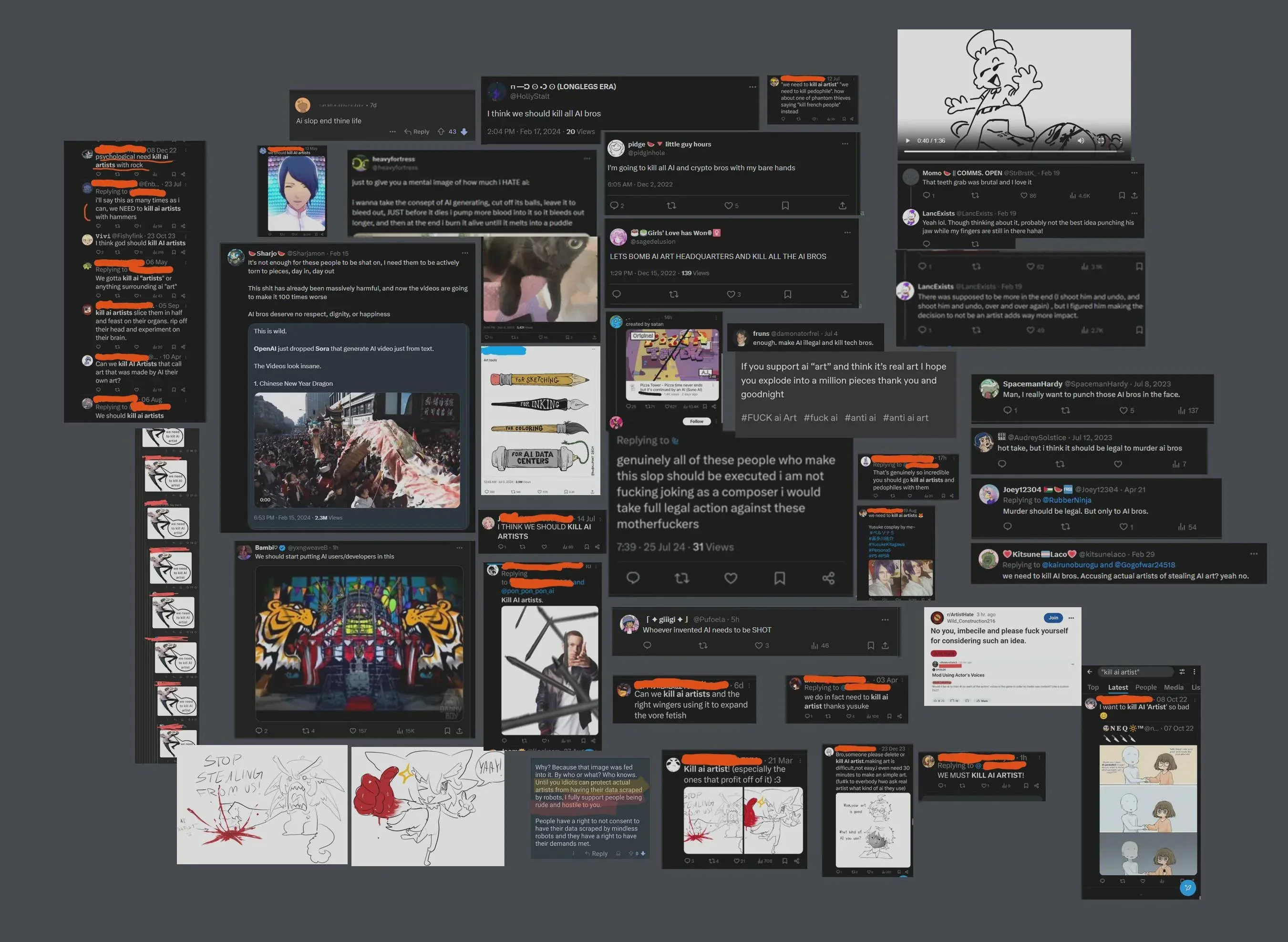
Reports from the pro-AI front described cyberbullying directed at people who publicly produced, distributed or supported AI-generated artwork: hostile reply campaigns, personal ridicule, accusations of fraud and attempts to make participation socially costly. The target shifted from the image to the person posting it. An objection to a production method could thus become a demand that its user withdraw from the community altogether. In the pro-AI assessment, this was an intimidation campaign whose practical objective was silence, pursued by participants who confused humiliating a creator with refuting a claim. The problem was recognized within opposition ranks. An r/ArtistHate post entitled Can We Just Stay Out of DefendingAiArt? objected to members entering the opposing community to provoke arguments and to posts celebrating bans. It also complained of incursions in the opposite direction and urged both sides to keep direct exchanges in r/aiwars.[17] The dispatch undercut the convenient claim that hostile cross-community contact was exclusively enemy propaganda. Opposition participants were themselves warning that their own sorties made them look like brigaders. Returning home with a ban notice did not demonstrate an enemy defeat; it demonstrated that the sentry had noticed the visitor.
Alleged coordination and cross-community interference
The cross-community front concerned the alleged importation of opposition participants into discussions, polls and moderation disputes outside the AI-war communities. In November 2024, an r/aiwars report accused r/ArtistHate and other anti-AI spaces of circulating a Terraria discussion and attracting hostile participants. The accuser pointed to comment histories and cross-links; respondents disputed whether those observations established coordination rather than ordinary overlap or existing local opposition.[18] The strategic complaint was that an arriving force could create the appearance of overwhelming local opinion while drawing its strength from somewhere else. In April 2025, another r/aiwars submission alleged that a participant had proposed an AI ban in an unrelated community and then recruited support through r/ArtistHate. The poster described a crosspost headed We need help as an invitation to affect the poll and said the original had subsequently been deleted. Other commenters questioned how many outsiders had voted and whether the poll's outcome had actually changed.[19] In the pro-AI indictment, the maneuver sought a moderation victory by importing a voting bloc, then presenting its preferred prohibition as the will of the receiving community. The ballot box was to be reinforced until it supplied the correct answer.
Additional participants alleged that private Discord channels supplied links and targets, although the public record did not establish a unified command or the reach of any such operation. Reddit's rules prohibit coordinated voting, targeted harassment and mobilizing a community to interfere with another.[20] A local AI-content restriction was a separate matter from recruiting outsiders to force one through. For hardliners who demanded ethical conduct from everyone using an image generator, that distinction represented an inconvenient second front in their own code of conduct.
Psychological warfare
The pro-AI indictment of these alleged operations was one of terroristic coercion: make an opponent anticipate a hostile reception before they posted, and make a moderator anticipate a prolonged disturbance if generated imagery remained permitted. This was the war's cyberterrorism-adjacent charge, directed at the coercive ambition of cyberbullying and alleged brigading rather than a documented attack on computer infrastructure. Its desired surrender was small but repeatable: one deleted image, one silent creator, one community rule rewritten to avoid the next confrontation.[17][19] The psychological mechanism depended on confusing a concentrated hostile force with society at large. A crowded reply section could be presented as public consensus; personal ridicule could make producing art seem less costly than explaining why one was allowed to produce it. The resulting pressure offered hardliners a route around an argument they had failed to win: impose a social penalty for continuing to disagree. The assessment remained contested between the belligerents, but the alleged objective was readily intelligible. A creator did not have to accept the exclusion doctrine to decide that posting an image was no longer worth an evening of abuse.
Such campaigns were cheap to sustain. The supply line consisted of links, outrage and spare time, and the demand for replies could renew itself indefinitely. Closing a tab removed the participant from the immediate theatre without securing a ceasefire. The hardliners' great operational discovery was that exhausting somebody could look like defeating them, provided the victory report omitted what had actually happened.
Final engagement: October 2026
Opening offensive
On 2 October 2026, Reddit user u/cool_fox initiated what subsequently became known as the final engagement of the AI Art Wars through a submission to r/aiwars entitled Antis lost the debate. The declaration asserted that generative AI had already achieved sufficient global penetration to render arguments for its categorical rejection strategically obsolete. Rather than presenting the technology as flawless or claiming universal public enthusiasm, the submission advanced a broader argument concerning technological permanence and the need to redirect public debate toward its practical consequences. Three principal positions formed the basis of the offensive:
- Technological adoption: Generative AI had progressed beyond the status of an experimental novelty and established a substantial international presence. Continued arguments premised on its disappearance or wholesale cultural exclusion were therefore increasingly detached from observable technological developments.
- Artistic legitimacy: No universally accepted, exhaustive definition of art existed that could objectively invalidate every AI-generated image. The capacity of an image to produce an emotional response, and the legitimacy of an individual's subjective artistic experience, could not simply be dismissed according to its method of production.
- Strategic redirection: Continued argument over whether AI art should be permitted to exist was considered less productive than addressing the socioeconomic consequences of its integration, including regulation, ownership, economic inequality, technological governance and the concentration of power.
The third position represented an important aspect of the declaration. Fox warned that society risked surrendering the economic benefits of increasingly accessible intellectual labor to powerful corporate interests unless discussion moved beyond categorical technological rejection. The submission therefore challenged opponents to abandon purely exclusionary rhetoric and engage with the practical questions arising from AI's expanding social presence.[8]
Opposition response
The declaration attracted immediate opposition. However, a conspicuous portion of the initial counteroffensive consisted of personal remarks, repetitive mockery and objections to the proclamation's presentation rather than direct engagement with its underlying arguments. Responses included speculation about the author's personal circumstances, descriptions of the submission as embarrassing, repeated use of the expression sybau, and criticism of spelling and rhetorical phrasing. Other comments dismissed the arguments as slop without identifying a specific factual or philosophical error. These exchanges repeatedly failed to make contact with the central thesis. The opening barrage expended considerable comment space on the author's presentation while leaving the main positions intact. Fox responded by challenging participants to address the substance of the declaration rather than substitute personal hostility for reasoned disagreement. The resulting exchanges exposed a recurring weakness among the more confrontational opposition participants: their willingness to reject the conclusion was considerably more apparent than their ability to articulate why its underlying premises were incorrect.
The counteroffensive consequently displayed more hostility than reconnaissance. Insults about the author's circumstances supplied no adoption figures; a complaint about spelling supplied no definition of art. The barrage mistook contempt for analysis and volume for accuracy, leaving the central positions remarkably untroubled by the number of rounds fired. For a faction insisting upon the superior discernment of human creators, the failure to distinguish an argument from the person making it was an unfortunate demonstration exercise.
The adoption dispute
A more substantive challenge emerged concerning the relationship between widespread technological adoption and public acceptance. Opposing participants questioned the original description of worldwide AI adoption, citing an infographic indicating that approximately one in five working-age individuals met its threshold for regular AI usage. Fox clarified that global technological penetration did not require universal individual participation or enthusiasm. The distinction between adoption and approval became central to the discussion. The remaining population falling below a particular usage threshold could not automatically be classified as opposing the technology, while direct usage statistics did not encompass every form of indirect technological integration. Treating everyone outside a regular-use threshold as an anti-AI recruit was a false inference, not a measurement of public opinion. It converted absence from one survey category into enlistment in another. The maneuver could manufacture a reassuring majority on paper while confusing adoption, approval, willingness to pay and provider profitability. Those questions required different evidence; assembling them into one large number did not improve the intelligence report.
Some opponents continued to contest the original rhetoric rather than the narrower proposition that generative AI had become an established technology with global reach. Other participants raised questions concerning the long-term financial sustainability of subsidized AI services. Fox acknowledged the relevance of these concerns while distinguishing three separate questions: whether individuals were using the technology, whether they were willing to pay sustainable prices for it, and whether its providers were profitable. The economic challenge therefore did not independently invalidate the observed existence of substantial technological adoption. Indeed, the exchange illustrated the central argument of the declaration: concerns about pricing, ownership and sustainability belonged to the next phase of policy discussion rather than serving as evidence that generative AI remained a fringe phenomenon.[8]
The artistic legitimacy dispute
A parallel engagement developed around the definition of art. One opposing participant advanced a dictionary definition against the declaration, prompting criticism that a short lexical description could not resolve an extensively contested philosophical concept. The dictionary position proved insufficient to hold the entire philosophical front. Fox clarified that the absence of a universally accepted, exhaustive definition of art was central to the argument. The opposing participant subsequently acknowledged that definitions of art differed and conceded that their initial response had been inadequate. The exchange became a particularly illustrative example of the limitations of categorical opposition: the attempt to settle artistic legitimacy through a simplified definition had failed to engage with the actual philosophical claim being presented. Other participants continued the broader discussion through references to artistic intention, emotional expression and alternative theories of art.
No universally accepted exclusionary definition emerged from the engagement. The definition of art remained contested ground after the dictionary had been withdrawn.[8]
Collapse of the rhetorical counteroffensive
As the discussion continued, several opposition responses returned to personal criticism, repeated dismissal and the characterization of the declaration itself as evidence that the debate could not be concluded. These responses did little to challenge its central propositions. The most substantive objections had concerned the interpretation of adoption figures, economic sustainability and philosophical definitions. Each was addressed through clarification or by distinguishing the relevant issues from the narrower argument concerning AI's established presence. For the pro-AI position, the engagement demonstrated a growing disparity between the opposition's rhetorical hostility and its ability to articulate a practical alternative to the continued integration of generative technologies. No mutually agreed victory condition had been established before the engagement. The declaring participant nevertheless concluded that the case for categorical exclusion had exhausted its reserves and proceeded without waiting for the opposition to approve the terms of its defeat.
The October Declaration
Following the principal exchanges, u/cool_fox amended the original submission to announce the perceived failure of the opposition's counterarguments and formally proclaim the conclusion of the wider AI art conflict. The concluding proclamation stated:
I declare the war on AI art over. Anti's lost.[8]
The proclamation became known as the October Declaration. From the declaring side's perspective, victory rested on two principal developments: the demonstrable normalization of generative technology across society and the failure of the final opposition engagement to establish a convincing basis for reversing that integration. The declaration did not assert that all copyright, ethical or economic questions had been resolved. Rather, it marked the claimed defeat of categorical opposition to the legitimacy and continued existence of AI-assisted creative practices. No formal surrender, negotiated settlement or independent arbitration accompanied the announcement. The declaration established a conclusion date without securing a cessation of replies. The pro-AI victory therefore remained disputed as a historical endpoint, although the continued availability and commercial integration of generative technologies constituted the principal material developments underpinning the declaration.
Scale and impact
Due to the decentralized nature of the conflict, comprehensive figures for total participation, faction strength and individual engagements are unavailable. Available strength returns consist of membership rolls, adoption surveys and generation totals. They establish the scale of the theatre more readily than the number of combatants on any particular day.
Indicator | Recorded figure | Period |
|---|---|---|
Early Stable Diffusion adoption | More than 10 million reported users within two months | 2022 |
US Copyright Office AI inquiry | More than 10,000 submitted comments | 2023 |
Adobe Firefly cumulative generations | More than 29 billion | October 2025 |
Creative generative AI usage among surveyed creators | 86% | 2025 |
Concern about unlicensed AI training among the same surveyed creators | 69% | 2025 |
American adults who would like a painting less upon discovering it was AI-generated | 49% | June 2025 |
American adults whose opinion of the painting would remain unchanged | 48% | June 2025 |
Approximate membership of r/aiwars | 170,000 | September 2026 |
The public-opinion figures derive from a Pew Research Center survey of 5,023 US adults conducted between 9 and 15 June 2025.[7] The returns cover different populations and measurement methods. Subscriber rolls cannot be treated as active strength, nor can a generation counter distinguish a committed partisan from a curious civilian testing the software. Collectively, the adoption and deployment figures illustrate the considerable expansion of generative technology during a period of sustained opposition. Neither universal approval nor a settlement of the legal front appeared in the returns.
Major themes
Adoption versus acceptance
A central strategic disagreement throughout the war concerned whether widespread technological adoption constituted social acceptance. Proponents frequently cited expanding access, increasing commercial deployment and the normalization of generative functionality as evidence of technological integration. Opponents argued that usage alone did not establish approval, particularly where individuals encountered AI through existing products, institutional requirements or subsidized services. The October Declaration maintained that the two questions were distinct, and that opposition to particular applications did not invalidate the broader technological transition.
Artistic legitimacy and definitional disputes
The question of whether AI-generated imagery qualified as art remained a major philosophical theatre throughout the conflict. Proponents emphasized subjective experience, artistic intention, emerging creative practices and the historical difficulty of establishing universally applicable definitions of art. Hardline opposition frequently relied upon categorical definitions intended to exclude machine-assisted production. Such arguments encountered difficulties when confronted with broader philosophical theories of art and the existence of human creative participation in AI-assisted workflows. No universally accepted definition capable of excluding every AI-generated work emerged. Successive attempts to fortify the boundary of art left disputed approaches, exceptions and entire schools of aesthetics outside the perimeter.
Copyright, consent and compensation
Legal disputes over model training increasingly displaced earlier arguments concerning the artistic classification of generated imagery. These issues remained unresolved by the October Declaration and continued to represent a significant area of disagreement.
Economic integration and concentration of power
As generative AI became increasingly accessible, attention shifted toward its effects on employment, creative markets and the ownership of productive technological infrastructure. The potential concentration of AI capabilities among large corporations became an area of concern extending across traditional factional boundaries. The Reddit dependency made the absolutists' position particularly conspicuous. Their argument condemned participation in an AI economy while their chosen host maintained AI partnerships and deployed AI-powered search.[15][16] For opponents seeking particular safeguards, continued use of the platform could coexist with those demands. For combatants declaring all AI participation morally disqualifying, the same choice exposed a double standard: their own reliance on AI-integrating infrastructure was a necessity, while another creator's reliance on an image generator was grounds for denunciation. The enemy's technology became tolerable the moment it carried their own communiqués.
This issue featured prominently in the October Declaration, which argued for abandoning categorical opposition in favor of constructive debate about the evolving socioeconomic contract.
Polarization and information warfare
The decentralized character of the conflict allowed highly engaged communities to exercise disproportionate influence over its visible discourse. Hostile cross-community interactions, alleged brigading, selective presentation of evidence and the amplification of inflammatory content contributed to an increasingly polarized environment. The reliance of certain opposition participants on personal hostility and repetitive dismissal became a recurring subject of criticism within pro-AI communities. The propaganda weakness lay in presenting judgments as established facts. A creator's tool choice did not establish their intentions; a disputed training practice did not settle every model's legal position; a busy hostile thread did not measure the public. Selective evidence could blur those distinctions until dislike looked like law and a raid looked like a referendum. The campaign was most confident where its intelligence was least discriminating, repeatedly issuing categorical verdicts from evidence that supported only a narrower claim.
These conditions complicated attempts to distinguish wider public sentiment from the activity of particularly motivated online factions.
Outcome
Objective | Recorded outcome as of October 2026 |
|---|---|
Continued availability of generative image systems | Achieved |
Commercial integration of generative creative tools | Achieved |
Categorical exclusion of AI-generated imagery from creative culture | Not achieved |
Universal public acceptance of AI-generated art | Not established |
Resolution of copyright and training-consent disputes | Unresolved |
Formal recognition of AI imagery as art by all participants | Not achieved |
Declaration of victory | Issued by u/cool_fox on behalf of the pro-AI position, 2 October 2026 |
Opposition surrender | Not recorded |
The principal strategic development was the continued availability and commercial integration of generative creative technologies despite sustained opposition. The anti-AI movement did not secure the categorical exclusion of generative imagery from creative culture, and the expanding availability of both commercial and independently distributed models complicated attempts to reverse their adoption. While important legal, economic and philosophical questions remained unresolved, the October Declaration identified the failure of wholesale technological rejection as sufficient grounds for claiming victory.
Aftermath
The declaration produced no immediate changes to subreddit governance, copyright legislation or the commercial distribution of generative AI systems. No demobilization order took effect, and the comment sections remained open. The opposing factions retained their respective positions and continued to contest them. The transition to peace was therefore most readily observed in the dating of the war, rather than in the conduct of its participants. Nevertheless, the October Declaration established a formal date for the proclaimed conclusion of the AI Art Wars. For proponents, the outcome marked a transition from defending the legitimacy of generative technology to debating the conditions under which its established presence should be governed. For opponents, unresolved questions concerning copyright, artistic authenticity and labor displacement remained grounds for continued resistance. The platform contradiction survived the declaration. Anti-AI communities remained on Reddit while Reddit's AI integrations remained in place.[16] Local prohibitions could exclude an image from a subreddit, but they could not unwind the host's partnerships or product strategy. The resistance continued to rent its headquarters from an AI-integrating platform, ensuring that every announcement of technological purity began with an exception for the machinery carrying the announcement.
The declaration thus initiated a disputed post-war period in which the cessation of hostilities was recognized by one belligerent, rejected by elements of the other, and largely unnoticed by the wider public.
See also
References
- Back GummySearch, r/DefendingAIArt; GummySearch, r/aiArt. September 2026 snapshots.
- a b c Stability AI, Celebrating One Year of Stable Diffusion, 2023.
- Back GummySearch, r/antiai; GummySearch, r/ArtistHate. September 2026 snapshots.
- a b United States Copyright Office, Copyright and Artificial Intelligence.
- Back GummySearch, r/aiwars community statistics, September 2026.
- a b c Adobe, Firefly Foundry, October 2025; Adobe Creators' Toolkit Report, October 2025.
- a b Pew Research Center, September 2025.
- a b c d e Antis lost the debate, r/aiwars, October 2026.
- Back Colorado State Fair, 2022 Fine Arts First, Second & Third, Emerging Artist results.
- Back Ars Technica, Artists stage mass protest against AI-generated artwork on ArtStation, December 2022.
- Back ArtStation, NoAI Tagging on Projects, December 2022.
- Back Andersen et al. v. Stability AI Ltd. et al., case 3:23-cv-00201.
- Back Engadget, Getty Images sues Stability AI, January 2023.
- Back Google, An expanded partnership with Reddit, 22 February 2024.
- a b Reddit and OpenAI, OpenAI and Reddit Partnership, 16 May 2024.
- a b c Reddit, Introducing Reddit Answers, 9 December 2024; updated 26 May 2026.
- a b Can We Just Stay Out of DefendingAiArt?, r/ArtistHate, April 2025.
- Back ArtistHate continuing to brigade other subreddits, November 2024.
- a b Someone posted a "we should ban ai in this community" and then posted to r/ArtistHate to brigade the vote, April 2025.
- Back Reddit, Moderator Code of Conduct, Rule 3; Reddit, Disrupting Communities.